Defence expenditure was pegged at 1.4 per cent of GDP in the Budget for 2025-26 but it may widen, depending on tensions between India and Pakistan.

Finance Minister Nirmala Sitharaman on Tuesday announced nine priorities in the Union Budget 2024-25 for generating ample opportunities in the economy. The nine priorities include productivity, jobs, social justice, urban development, energy security, infrastructure, innovation and reforms.

The Central Board of Indirect Taxes and Customs (CBIC) announced the implementation of the Eligible Manufacturer Importers (EMI) scheme from April 1, allowing eligible importers to defer customs duty payments.

Union Home Minister Amit Shah has announced a significant increase in Lok Sabha seats for the five southern states following delimitation, countering misinformation and clarifying the timeline for women's reservation implementation.

The entire Budget-making exercise will be advanced by 3-4 weeks so as to complete the legislative part of financial business before April 1, the start of a financial year

Here are handful of the number of amendments expected and predicted by analysts in the Union Budget for 2013-2014.

Union Home Minister Amit Shah has promised to expel infiltrators from West Bengal and secure the border if the BJP wins the upcoming assembly elections. He accused Chief Minister Mamata Banerjee of neglecting North Bengal and favouring Muslims in budget allocations.
The Budget session of the Parliament is likely to begin from February 25 with the Presidential Address to a joint sitting of Lok Sabha and Rajya Sabha followed by presentation of rail budget and general budget on February 26 and 28.
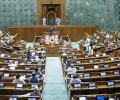
The deportation of Indians from the United States, deaths in the Maha Kumbh stampede and the joint Parliamentary committee report on the Waqf bill were among the issues that led to heated exchanges and some disruptions in an otherwise smooth first part of the Budget session that ended on Thursday.
Finance Minister P Chidambaram presented the Interim Budget for 2014-15 on Monday.

Benchmark equity indices Sensex and Nifty extended their gains for the second straight session on Monday, driven by optimism over the India-US trade deal and robust buying in public sector banks, consumer durables, and realty stocks.
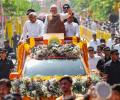
A downsizing in the prime minister's convoy was implemented in his recent domestic visits, official sources said.
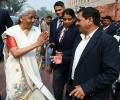
The Department of Social Justice and Empowerment has received Rs 13,611 crore in the Union Budget announced on Saturday, while the allocation for disability welfare now stands at Rs 1,275 crore.

Inflation data, trading activity of foreign investors and global trends would dictate sentiment in the stock market this week, according to analysts.
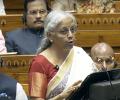
Here are some facts related to the Budget presentation in independent India.

'Grassroots-level corruption, which disrupts the last-mile work, cannot be ignored in your enthusiasm and drive to get going to complete the project.' 'Like it was in MGNREGA, in some states, it is the case with the Jal Jeevan mission.' 'The last minute levels of corruption can ruin the intent of the project itself.' 'When you see that people can game a particular well-intended and well-crafted project, you need to correct that.'

Union Home Minister Amit Shah promised to resolve the decades-old Gorkha issue within six months if the BJP comes to power in West Bengal, addressing a rally in Kurseong, Darjeeling district.

Business confidence in India Inc rose to a five-quarter high in December quarter of FY26, amid further reform expectations and steady domestic demand, a survey by industry body Confederation of Indian Industry (CII) showed. The CII Business Confidence Index (BCI) rose for the third consecutive quarter to 66.5 in the December quarter from 66 in the preceding September quarter.

The Indian economy is likely to grow at 7.4 per cent in 2025-26, up from 6.5 per cent in the previous fiscal, mainly on account of better performance of manufacturing and services sectors, as per the government data released on Wednesday.

After three consecutive months of heavy selling, foreign portfolio investors (FPIs) turned net buyers in the first week of February, infusing more than Rs 8,100 crore in Indian equities, aided by improving risk sentiment, along with a trade deal with the US.

'This Budget has a one-year agenda, which you can call the sprint, and the marathon is towards Viksit Bharat.'

A forum of swamijis has urged the Congress high command to immediately appoint D K Shivakumar as the Chief Minister of Karnataka, warning of consequences if the demand is not met.

The pre-Budget proposals sent to the finance ministry aim to bring uniformity in tax treatment for investments in different financial sectors, mitigate hardship to retail taxpayers, and encourage participation in mutual funds.

The TMC and BJP are clashing over Bengal's food culture, with allegations of potential dietary restrictions adding spice to the West Bengal election campaign.

The Halwa ceremony, marking the final stage of the budget preparation process for Interim Union Budget 2024, was held in North Block on Wednesday in the presence of Union Finance Minister Nirmala Sitharaman. Union Minister of State for Finance Dr Bhagwat Kisanrao Karad was also present. A customary halwa ceremony is performed every year before the "lock-in" process of Budget preparation begins.
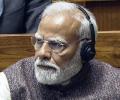
Prime Minister Narendra Modi has lauded the Union Budget as a "people's budget" that fulfills the dreams of every Indian and said that it is a "force-multiplier" that will boost consumption, investment and growth. He highlighted a host of measures for different sectors, including welfare initiatives for gig workers, tax relief for the middle class, and support for the manufacturing sector.

Finance Minister Nirmala Sitharaman on Tuesday participated in a traditional 'halwa' ceremony, marking the final stage for preparation of Union Budget 2024-25 to be unveiled on July 23 in Lok Sabha. The ceremony is a ritual in which traditional dessert 'halwa' is prepared and served to officials and staff members of the finance ministry who are involved in the preparation of the Budget.

Significantly, about half of the CEOs who took part in the survey indicated that they propose to increase their investments in near future, 45 per cent cited no change in investment levels, while only 5 per cent expected a fall.

With the three-day special sitting of Parliament on the constitution amendment bill related to the implementation of 33 percent reservation for women from the 2029 Lok Sabha polls set to begin on Thursday, a meeting of opposition parties is slated to be held on Wednesday at the residence of Congress president Mallikarjun Kharge.

Currently, Railways is facing a loss of Rs 34,000 cr in passenger segment and its earnings are falling.

The Income Tax Department has clarified that income from the transfer of investments made before April 1, 2017, is excluded from the scope of the General Anti-Avoidance Rules (GAAR), addressing industry concerns about retrospective application.

The market breadth ended weak on the BSE with 2,086 shares declining and 893 shares advancing.
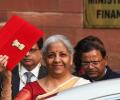
'... that it once again shies away from renewing its commitment to strategic divestment,' points out A K Bhattacharya.
It's time to focus on building a modern information system for Union excise and state VAT.

Rahul Gandhi said that had an INDIA Bloc government negotiated the trade agreement with the US, it would have told US President Donald Trump that he should treat India as an equal.

Stock market benchmark indices Sensex and Nifty ended 2.5 per cent higher on Tuesday after India and the US agreed to a trade deal under which Washington will bring down the reciprocal tariff on Indian goods to 18 per cent.

The outcome of the Union Budget, quarterly earnings from corporates and global trends are the major factors to drive stock market sentiments this week, analysts said. Besides, the trading activity of foreign investors, the rupee-dollar trend and the movement of global oil benchmark Brent crude are also crucial aspects to watch out for.

Rijiju, however, did not specify when and who will give notice for privilege motion against Gandhi. It is believed that someone from treasury benches in the Lok Sabha will do so.

The Tamil Film Producers Council (TFPC) has resolved to implement a revenue-sharing model for big-budget films, requiring actors and technicians to share profits and losses. The move aims to address financial pressures from declining theatrical and OTT revenues. The TFPC also mandated staggered OTT release windows and formed a committee to ensure access to theaters for smaller films.

As the March 31 deadline arrives, a wave of Maoist surrenders suggests insurgency's end, but political and social concerns remain.
